
I’ve been running bin rentals and mini excavation on Mid Vancouver Island for a while now, and there are a handful of questions I get asked over and over — and a handful of things I wish every customer knew before they booked, not after. Not because it changes what we do for you, but because it usually saves you money, time, or a headache.
This is that list. Straight from the crew — no marketing polish, just the stuff we’d tell you if you called us on the phone right now.
— The All Canadian Team
1. There Are Materials You Just Can’t Put in a Rental Bin
This is the single biggest surprise for people. When you rent a bin, you can’t just throw anything in it. Vancouver Island landfills (RDN and beyond) refuse certain materials at the gate, and if we show up to dump a load with banned material mixed in, we get turned around — and you get charged extra to sort or dispose of it separately.
What’s not allowed in a standard bin
- Hazardous chemicals — paint (unless dried solid), solvents, pesticides, motor oil, antifreeze, batteries
- Propane tanks — even small ones. Take these to a Product Care depot.
- Tires — go to a Tire Stewardship BC drop-off (free)
- Appliances with refrigerant — fridges, freezers, AC units. These need refrigerant reclamation first.
- Electronics (e-waste) — TVs, computers, monitors. Return-It Electronics depots take these free.
- Asbestos — needs a licensed abatement contractor, always
- Medical waste, biohazards
- Contaminated soil (call us — sometimes we can arrange separate handling)
What’s fine
- Construction/demolition debris (wood, drywall, roofing, tile)
- Household junk (furniture, mattresses — small extra fees may apply)
- Yard waste and brush
- Concrete and rubble (bin-load limits apply — call us for weight)
- Cardboard, wood, paper (yes — see below)
We wrote a full guide on this: what you CAN’T put in a rental bin in the RDN. Read it before booking if you’re doing a big cleanout.
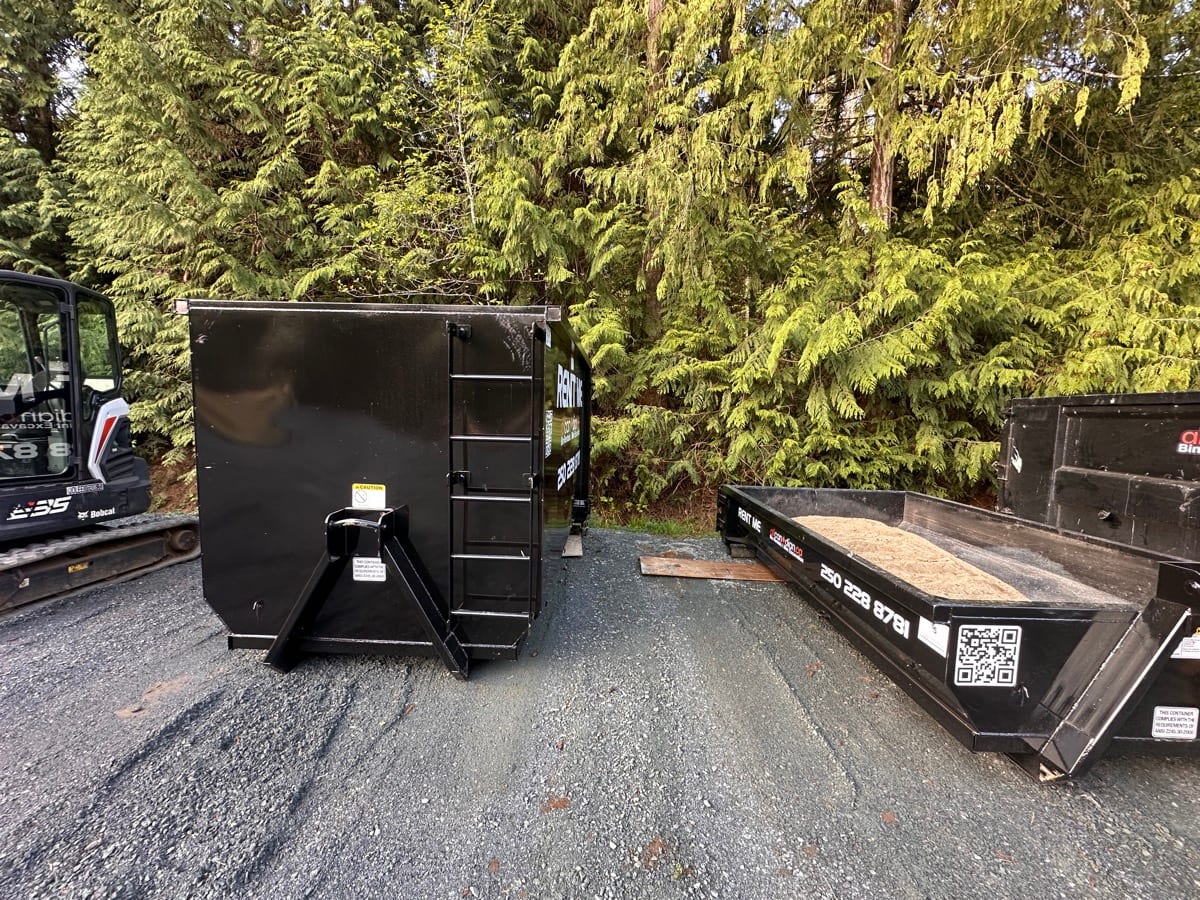
2. Yes, Cardboard Is Fine — And This Question Keeps Coming Up
This one surprises me every time. Customers regularly ask, “Can we put cardboard in?” And I get why they ask — everyone knows cardboard is recyclable, and they’re worried they’ll get in trouble for wasting it.
The honest answer: yes, cardboard goes in the bin. Same for paper, packaging, wood, and general recyclables. It goes to the landfill’s mixed-load area and gets sorted.
That said — if you have a huge volume of pure cardboard (like a warehouse cleanout with dozens of clean, flattened boxes), take that separately to a recycling depot. You’ll save a bit on bin weight and it’s better for the environment. But for a standard renovation or cleanout with mixed materials? Cardboard in the bin is perfectly fine.
The one thing I do ask: flatten it. Air is expensive. A bin full of un-flattened boxes fills up 3x faster than one packed tight, and you end up paying for space you didn’t need.
3. The Biggest Misconception: “It’s Cheaper to Just Do Dump Runs Myself”
I hear this from at least half the customers who first call us:
“I could probably just haul this to the dump in my truck a few times and save money.”
Here’s the honest math. If you have one small load — a couple of contractor bags of drywall, maybe a broken lawn mower — yeah, a dump run is fine. Fuel is cheap, the drop fee is minimal, and you’re done in an afternoon.
But here’s where people misjudge:
Renovation cleanouts and yard cleanups are rarely one trip. Most people book a bin because they’re doing a bathroom demo, roof tear-off, garage cleanout, deck removal, or big spring yard cleanup. That’s not one trip — that’s five to eight trips minimum, spread over a weekend or two.
Now do the math on YOUR time. Say each trip is 45 minutes loading + 30 minutes driving + 20 minutes at the landfill + 30 minutes back home = ~2 hours. Times 6 trips = 12 hours of your life.
Now fuel and landfill fees. Fuel isn’t free (your truck’s not doing city miles at that load), and landfill drop fees add up per trip.
Now the mess. Your truck bed. Your driveway. Your body — hauling drywall or roofing debris out of a truck alone is hard on your back.
For a mid-sized job (any renovation, roof, or serious cleanup), a bin is almost always cheaper when you factor in your time and fuel. We do the trip. We handle the loading logistics. Your yard stays cleaner because the bin lives there for a few days instead of debris piling up while you plan your next trip.
Full breakdown of the math: Nanaimo landfill fees vs renting a bin and bin rental vs Parksville transfer station.
4. Book Earlier Than You Think You Need To
Bin availability is real, especially in our busy seasons (spring and fall). Here’s the reality:
- Spring (March–May) — everyone’s doing yard cleanup at once. Bins book out 1–2 weeks ahead sometimes.
- Fall (September–November) — same thing. Leaves, storm cleanup, end-of-season projects.
- Summer (June–August) — renovation-heavy. Roof jobs, deck rebuilds, contractor projects.
If you know you’re doing a project, call us as soon as you know the date, not the day before. We do our best to fit last-minute calls in, but if you’re planning a specific weekend of work, book 3–5 days out. During peak season, a week is safer.
We’re a small local business — that’s a good thing for you (see #6 below) — but it also means we don’t have unlimited bins sitting around. When our bins are out, they’re out.
5. The Off-Season Is a Great Time for Interior Projects
People think of bin rentals as a spring/fall thing. But some of my favorite jobs are winter interior renovations, garage cleanouts, and rental property turnovers.
Winter is actually a great time to rent a bin because:
- Availability is high
- Weather is inside-friendly for demo work
- Contractors are less busy so scheduling other trades is easier
- Rental property cleanouts happen year-round
If you’re a landlord doing a tenant turnover — bathroom re-do — kitchen re-do — garage cleanout — we’re here in the off-season too, and you’re not competing with everyone else for bin availability.
6. Talk to Us About the Whole Project, Not Just the Bin
Some of the best jobs I’ve done are the ones where the customer called for a bin and ended up saying, “By the way, we also need to dig a trench for the new water line, do you do that?” or “We’re planning to bring in gravel for the driveway after this — can you do that too?”
Yes. We do bin rentals, mini excavation, utility locating, material delivery, and debris removal — all under one roof. If your project involves more than just a bin, tell us upfront. Combining jobs almost always saves money on delivery fees, saves time on scheduling multiple contractors, and lets us plan the sequence properly (bin drops after excavation, not before — that kind of thing).
I wrote more about this here: when a bin AND an excavator together save you money.
7. Why Customers Pick Us Over the Bigger Guys
I’ll be straight — I don’t like doing self-promo. But this comes up in almost every customer conversation and it’s worth saying:
The three reasons customers tell me they picked us over the bigger companies:
- Quick response time. You call, you get a real person, usually me. Not a call center.
- Weekend availability. Most of the bigger regional players don’t drop bins on Saturdays. We do, most of the time.
- Customer service. We show up when we say we’ll show up. If something changes, we call. Nobody gets left wondering.
And honestly — a lot of Mid Vancouver Island customers just prefer the local guy. Someone who lives here, works here, sees you at the grocery store. The bigger corporate outfits from up-Island or the mainland don’t care the same way, and it shows in how they answer the phone.
I’m not saying we’re perfect. But if something goes sideways, you can talk to the owner directly and get it fixed. That matters to a lot of people.
Ready to Book?
Call 778-909-9874 or fill out the contact form. Tell me what you’re doing and what your timeline looks like, and I’ll help you figure out what size bin (or what combination of services) makes sense.
Related Reading
- What you CAN’T put in a rental bin in the RDN
- Bin rental vs Parksville transfer station
- 15-yard vs 20-yard bin: how to choose
- When a bin AND excavation together save you money
Frequently Asked Questions
Can I put cardboard in a rental bin? Yes. Cardboard, paper, packaging, and wood all go in a mixed-load rental bin. If you have a warehouse volume of clean cardboard only, take it to a recycling depot separately — otherwise flatten it and toss it in.
How far in advance should I book a bin? In spring and fall, book 5–7 days ahead if possible. In winter or summer, 2–3 days is usually enough. Last-minute is possible but not guaranteed.
Is renting a bin actually cheaper than dump runs? For most projects that need more than one truckload, yes — when you factor in your time, fuel, and multiple landfill fees. For a single small load, dump runs are fine.
What can’t I put in a rental bin? Hazardous chemicals, paint (unless dried), propane tanks, tires, refrigerated appliances, asbestos, medical waste, and e-waste. Everything else that’s normal construction, renovation, yard, or household waste is fine.
Can I book a bin and mini excavation at the same time? Yes — and it usually saves money. Combined jobs share the delivery fee and lets us plan the sequence properly. Just tell us the full project when you call.
Do you deliver bins on weekends? Yes, most weekends. It depends on the schedule that week, but weekend delivery is one of our standard offerings.